News · 20 February 2026
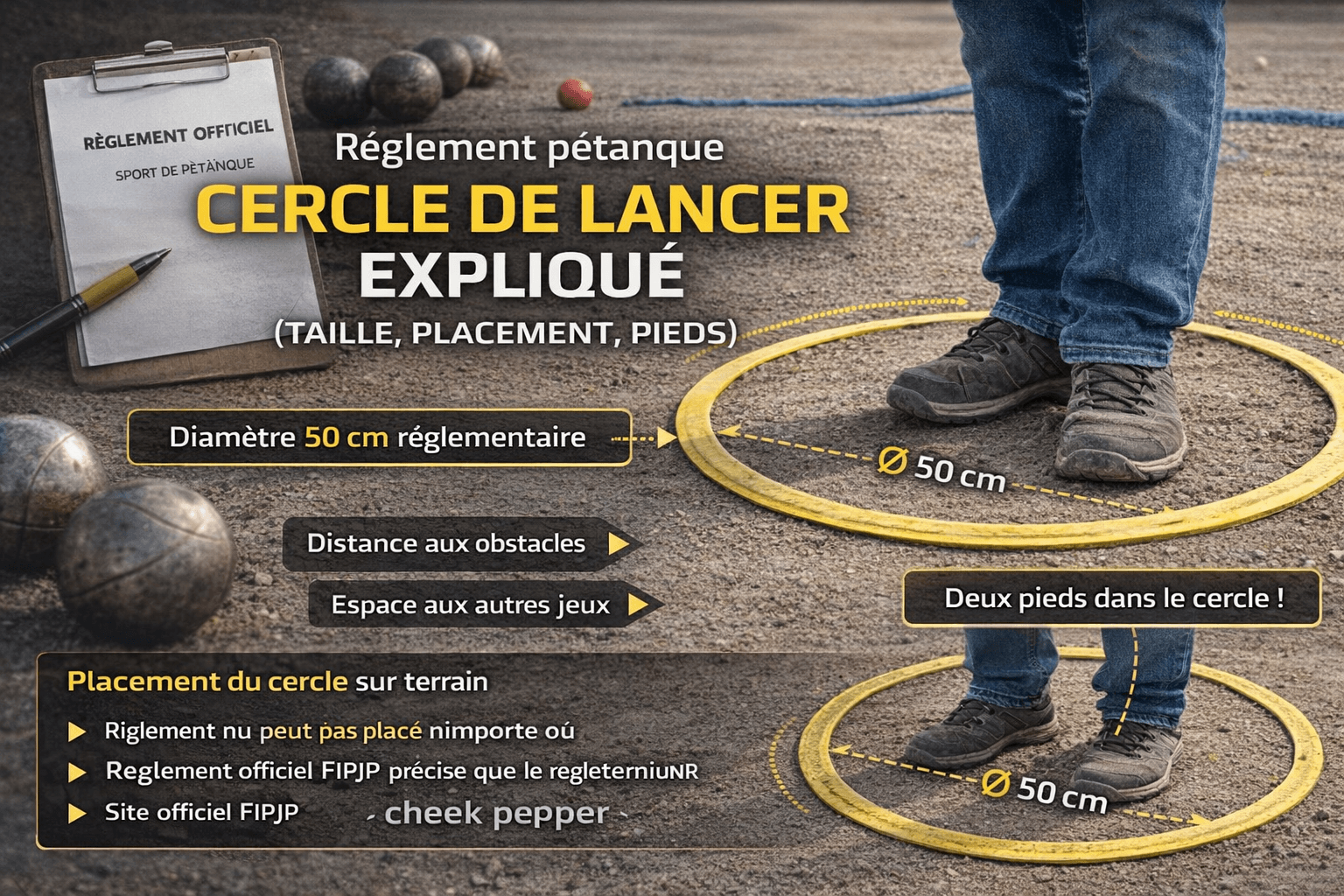
Pétanque rules: the throwing circle (size, placement, feet in the circle)
NewsA drawn or rigid circle, regulation size, placement, feet in the circle: everything the FIPJP rules say about the throwing circle in pétanque.What's the throwing circle for?
The throwing circle has two official functions in the FIPJP rules:
- 🎯Defining the starting point of each throw — the jack (cochonnet) and then all the boules of the end are thrown from this circle. Its position therefore determines the measured distance and the validity of each shot.
- ⚖️Guaranteeing fairness between players — by fixing an identical position for everyone, the circle stops a player from quietly moving their throwing point from one boule to the next or from one end to the next.
- 🔄Serving as a reference for the next end — at the end of an end, the circle is repositioned around the cochonnet that has just been scored. The continuity of play rests on this regular relocation.
Drawn circle, rigid circle: the two official options
The FIPJP rules recognise two ways of marking out the throwing circle. These two options aren't equivalent in all circumstances — and since 2026, the use of the rigid circle has been strengthened in official competition.
⭕ Circle drawn on the groundDrawn by hand with a finger, a stone or a stick. Valid in friendlies and in competitions that don't provide a rigid circle. Must respect the regulation diameter.
✓ Allowed 🔵 Approved rigid circleA circle made of plastic or other hard material, with a regulation internal diameter. Mandatory in official competition when the organiser provides one. Folding versions allowed if approved.
✓ Mandatory in sanctioned competition ⚠️ Unapproved rigid circleA homemade rigid circle, the wrong size or not approved by the FIPJP/FFPJP doesn't replace a regulation circle. It can be contested in competition.
⚠ Subject to conditions 🚫 Circle absent or not marked outPlaying with neither a drawn circle nor a rigid circle isn't compliant with the rules. In an umpired competition, the umpire can step in to require the circle to be placed before play continues.
✗ Not compliant 🔗Since 2026, the FFPJP has strengthened the requirement to use a rigid circle in official French competitions. Our dedicated article details all the new developments on the mandatory rigid circle in 2026.
Regulation circle size
The FIPJP rules precisely govern the diameter of the throwing circle. It's not a detail: a circle that's too big allows advantageous throwing positions, a circle that's too small restricts the player in a non-regulation way.
| Circle type | Diameter | Measurement reference | Status |
|---|---|---|---|
| Circle drawn on the ground | 35 to 50 cm | Internal diameter of the drawing | Compliant |
| Approved rigid circle | 35 to 50 cm | Internal diameter of the circle | Compliant |
| Approved folding rigid circle | 35 to 50 cm | Internal diameter when deployed | Allowed if approved |
| Out-of-spec circle (too big or too small) | < 35 cm or > 50 cm | — | Not compliant |
A club or organiser that provides non-compliant rigid circles (out-of-spec diameter or an unapproved model) exposes the competition to disputes during play. Checking the equipment's approval before the competition avoids this kind of dispute.
Circle placement on the court
The circle can't be placed just anywhere. The rules impose minimum distances to respect relative to the court's features. A misplaced circle can be contested before the first boule is even played.
🧱 Distance from fixed obstaclesThe circle must sit at a minimum distance from walls, edging, trees and any fixed obstacle on the court. A circle flush against a wall is not compliant.
⚽ Distance from other circlesIn competitions with several adjacent games, the circles must respect a minimum distance between them. The proximity of another game can invalidate a placement.
🏁 Authorised playing zoneThe circle must be placed within the playing zone defined for the game. Outside the zone or on a court boundary, it isn't compliant.
🔄 Continuity from end to endBetween each end, the circle is repositioned around the scored cochonnet. This relocation must itself respect all the regulation placement distances.
💡 Paquita's adviceOn tight courts or in competitions with many simultaneous games, circle placement is the number-one source of avoidable disputes. Taking 5 seconds to check the position before starting the end avoids disputes during the game — and needless tension. If in doubt, call the umpire before the first boule.
The feet-in-the-circle rule
It's the most important rule for players — and the one that generates the most involuntary faults. The FIPJP rules are precise on three obligations that follow on from each other in time:
1️⃣ Before the throw — both feet entirely inside the circle When preparing to throw, both feet must be entirely inside the circle. A foot on the rim, a heel overhanging — that's a fault. The notion of 'entirely' includes the sole of the foot, the heel and the toes. ✓ Compliant if both feet are entirely inside 2️⃣ During the throw — no ground contact outside the circle During the throwing motion, the player must not take support on the ground outside the circle. Some players, when shooting, tend to place the tip of a foot outside the circle for balance — that's an infringement. ✗ Fault if external support is taken during the motion 3️⃣ After the throw — don't leave the circle before impact The player must stay in the circle until the boule has touched the ground. It's the most frequent error: the body's natural forward motion after a shot brings the foot out before impact. Even if involuntary, it's an infringement. ✗ Fault if the foot leaves the circle before the boule's impact ⛔ The most frequent faultLeaving the circle early after a shot. The body's forward motion is so natural that the majority of players don't realise they cross the rim before their boule lands. In an umpired competition, it's an infringement the umpire can flag — and which can invalidate the throw.
Practical scenarios on the terrain
👟 A heel overhangs the circle slightly during the throw Both feet must be entirely inside. A heel edging over the rim of the circle — even by a few millimetres — is a regulatory infringement. In an umpired game, the umpire can intervene. → Infringement — foot outside the circle 🏃 The player takes a step forward after their shot — their boule is still in the air Leaving the circle before the boule touches the ground is an infringement, even if the boule has already left the hand. The rules require staying in the circle until ground impact. → Infringement — early exit ✅ The player throws, waits for impact, then leaves the circle Perfectly compliant. The player respected the three conditions: feet entirely inside the circle, no external support during the motion, exit after the boule's impact. → Valid throw 📐 The drawn circle is too big — 55 cm in diameter An out-of-spec circle (over 50 cm) isn't compliant. In an umpired competition, the opponent can contest it and the umpire can ask for a regulation circle to be redrawn before play. → Non-compliant circle — to be corrected 🧱 The circle is placed 20 cm from a court wall Too close to a fixed obstacle. The placement isn't compliant with the regulation distances. Before the first boule, the opponent or the umpire can ask for the circle to be repositioned. → Non-compliant placement — call the umpire ♿ A disabled player can't keep both feet in the circle The FIPJP rules provide adaptations for disabled players — notably those in wheelchairs. These adaptations are governed by specific rules and don't constitute an infringement. → Provided regulatory adaptationCommon mistakes to avoid
- ✗A foot touching or crossing the rim — check that each foot is entirely inside, including heel and toes, before throwing.
- ✗Leaving the circle before the boule's impact — the most common fault, often involuntary. Drill this reflex in training so the wait becomes automatic.
- ✗A drawn circle that's too big 'to be comfortable' — an out-of-spec circle advantages the player and can be contested. Stay within the 35–50 cm range.
- ✗A circle placed too close to a wall or edge — the placement must respect the regulation distances from obstacles. Don't improvise on a tight court.
- ✗Using an unapproved rigid circle — in competition, only approved circles are valid when the organiser provides them. Don't bring your own non-compliant circle.
- ✗Moving the circle between two boules of the same end — the circle stays in place for the whole end. Moving it between two throws is an infringement.
Before each end: (1) check the circle is properly placed, (2) place both feet entirely inside, (3) wait for the boule to touch the ground before stepping out. These 3 seconds of rigour prevent 90% of disputes related to the throwing circle.
FAQ — Your frequent questions
Should the circle stay in place throughout the entire run? + Yes. Once placed at the start of the end, the circle must not be moved until the end of this end — whether between two throws by the same player or between the turns of the two teams. Moving it is an offense. If the circle is accidentally moved (a player steps on it, a ball hits it), it must be returned to its original location. Can we play with a circle drawn on concrete or asphalt? + Yes, provided that the regulatory diameter is respected and that the route is visible. On hard ground, the circle is often drawn with chalk or marked with a temporary coat of paint. In official competitions on hard ground, rigid circles are generally provided by the organizer and their use is essential. What is the penalty if a player leaves the circle before impact? + In refereed competitions, the referee can invalidate the throw and request that the ball be replayed. In the event of repeat offenses or deliberate misconduct, a disciplinary sanction may be imposed. In a game without a referee, the opponent must report the infraction immediately — not after the ball stops. A late challenge is difficult to assert. Does the rigid circle need to lay flat or can it be tilted slightly? + Ideally, the circle should lie flat on the ground. On uneven terrain, a slight tilt may be unavoidable — the important thing is that the circle is stable, its position is clearly defined, and that the player can place both feet completely on it. A circle that moves or does not stay in place must be replaced or traced on the ground. Can you use your foot outside the circle for balance after a shot? + No. The regulations do not authorize support on the ground outside the circle, neither during the gesture nor during the waiting phase for impact. A player who tiptoes out of the circle to balance while shooting is in violation. The throwing technique must be adapted to remain in the circle until the ball impacts. Does this rule also apply to the goal throw at the start of the end? + Yes. The jack throw at the start of the end is subject to the same position rules in the circle as the boule throw. The player who throws the goal must have both feet completely in the circle and wait until the jack has stopped before leaving - not the impact on the ground, but the complete immobilization. Our article on validity of the jack throw details the full conditions. 📚 Official sources- 🔗 Official FIPJP Rules — fipjp.com
- 🔗 Official FFPJP Rules — full commented version on petanqueland.fr
© Pétanque by Paquita — petanqueland.fr
Content based on the official FIPJP rules. In case of doubt, always consult the official version in force.