News · 20 February 2026
Pétanque rules: distance of the jack (cochonnet) from 6 to 10 metres
NewsThe regulation distance of the jack in pétanque: 6 to 10 metres, but not only that. Visibility, obstacles, back lines... everything the FIPJP rules really require.The 6-to-10-metre rule — what the rules really say
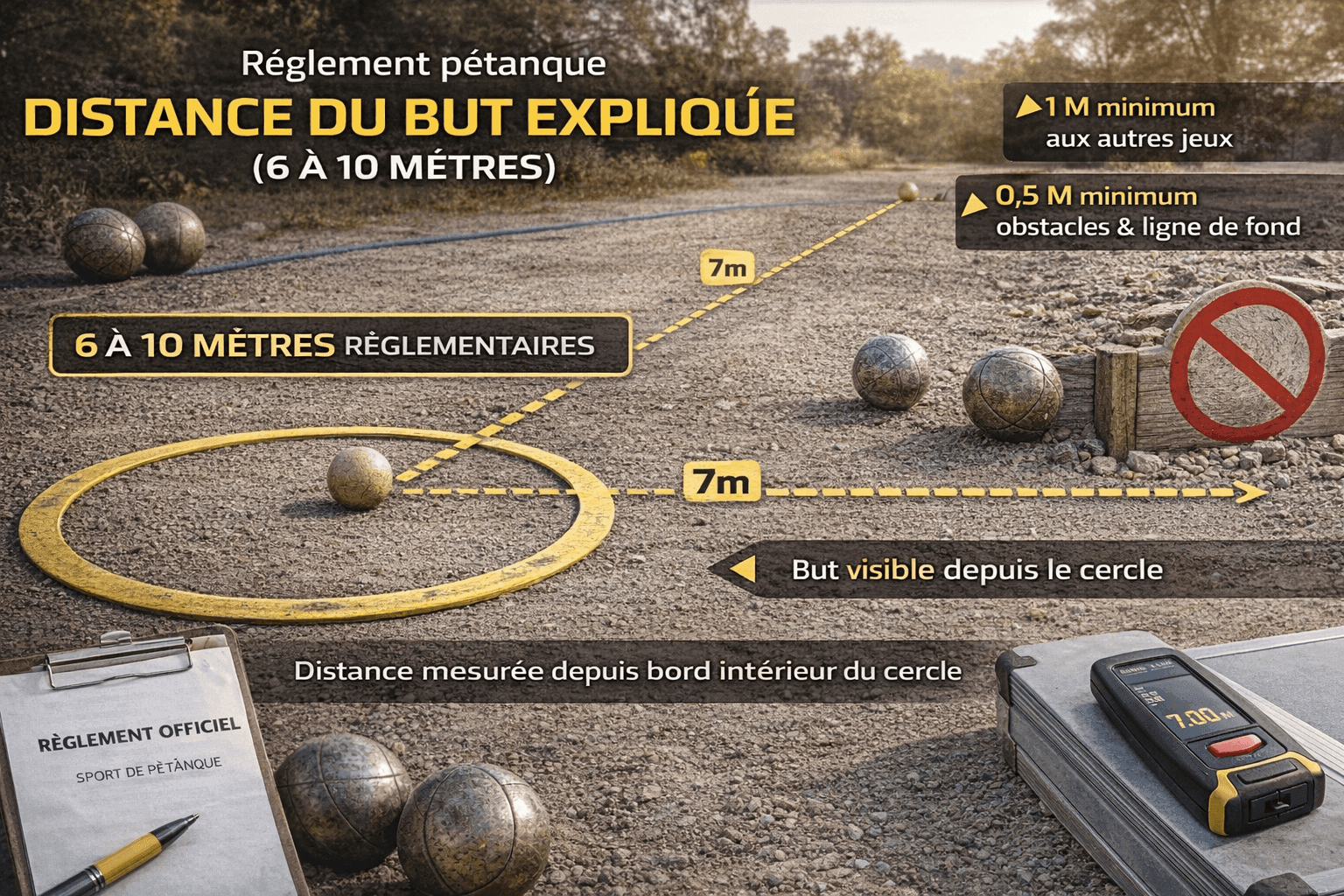
The official FIPJP rules specify that the distance is measured from the inner edge of the circle to the jack — not from the centre of the circle, not from the player's feet. This measuring point is precise and often misapplied in friendly games.
📏 JACK VALIDITY ZONE VALID ZONE 0 m 6 m ← min regulation zone max → 10 m + Invalid zone Valid zone Measured from the inner edge of the circle — not from the centre, not from the player's feet. 📄 FIPJP principle For junior and senior players, the distance between the inner edge of the circle and the jack must be between 6 metres minimum and 10 metres maximum. If the jack is thrown too short or too long, it is not valid and the procedure laid down by the rules applies. Source: Official FIPJP rules — Article on throwing the jack ⛔ Classic measuring errorThe official measuring point is the inner edge of the circle. Measuring from the centre of the circle or from your feet gives a result different by several tens of centimetres. In competition, this gap can invalidate a throw everyone thought was valid.
The other distances to respect (often forgotten)
The 6–10 metre rule is necessary but not sufficient. A jack exactly 7 metres from the circle can be perfectly non-compliant if it doesn't meet the other placement conditions. That's why a jack is never automatically valid just because it's in the right distance range.
🧱 Distance to obstaclesThe jack must be at a minimum distance from any fixed obstacles present on the pitch. A jack tight against a wall or a pitch edge can be invalid even at 8 metres.
🏁 Distance to the back lineThe jack must respect a minimum distance from the pitch's back line. This condition is often ignored in friendly games on open ground, but it applies in competition.
⚽ Distance to other gamesIn competition with several adjacent games, the jack must be far enough from the other ends in progress. The proximity of another game can invalidate the placement.
⭕ Authorised playing zoneThe jack must land and stay within the playing zone defined for the game. A jack out of bounds — even at a good distance from the circle — is not valid.
💡 Paquita's adviceMemorise this: distance is the baseline condition. The other conditions (obstacles, back line, other games) are additional filters that can invalidate a throw that's nonetheless in the right distance range. Checking in order avoids missing a non-compliant throw.
Jack visibility from the circle
It's one of the least-checked conditions in practice — and one of the most important. The rules require the jack to be visible from the throwing circle under the prescribed conditions. A jack hidden behind a fixed obstacle or in a deep hollow may not be valid.
- 👁️The player about to throw must be able to see the jack from the circle. It's them who's concerned, not the spectators or team-mates positioned elsewhere.
- 🪨A natural feature (hollow, mound) can mask the jack without anyone being at fault. The rule sets out precisely the conditions in which visibility is required.
- 🎳A boule in front of the jack (hidden jack) is a special case treated differently. A jack partially masked by a boule often remains valid. See our dedicated article on the hidden jack.
- ⚖️In case of disagreement on visibility, it's the umpire who decides in competition. In a friendly game, the right reflex is to check together before the first boule is played.
Jack visibility at the throw and a dead jack during the end are two separate questions. For anything that happens after the first boule played, see our article on the 7 cases of a dead jack during an end.
Difficult pitch: what to do when you can't place the jack?
Some pitches — too short, cluttered, with other games too close — make the regulation placement of the jack very difficult, or even impossible from a given circle. The rules provide an official procedure for these situations. There's no valid house rule — the official procedure exists and must be applied.
1 The same team tries to re-throw from the same circle If the first throw is invalid (too short, too long, bad placement), the same team gets a second attempt from the same circle position before the procedure moves on. 2 If still impossible: the right passes to the opposing team After one or more unsuccessful attempts, the opposing team gets the right to place the jack in a regulation position of their choice — within the authorised limits. 3 As a last resort: repositioning the circle In the most stuck situations, the rules may allow the throwing circle to be moved to a new valid position. This case must be validated by the umpire in competition. 4 In competition: call the umpire at the first doubt Don't improvise. The umpire knows the exact procedure and applies the rules according to the pitch context. Any solution invented between players can be contested and invalidate the end.Practical scenarios on the terrain
📏 The jack lands at 5.5 metres Below 6 metres, the minimum distance isn't reached. The throw is not valid, even if the jack is visible and well placed on the pitch. The same team must re-throw. → Invalid jack — to be re-thrown 🎯 The jack is at 7 metres but tight against a tree Correct distance, but too close to a fixed obstacle. The distance-to-obstacles condition isn't met. The jack is not valid despite the right distance range. → Invalid jack — non-compliant ✅ The jack is at 8.5 metres, visible, far from obstacles All conditions are met. The jack is valid. If no one contests before the first boule is played, the position is acquired for both teams. → Valid jack — play on 🔁 The team misses the valid zone twice After unsuccessful attempts from the same circle, the opposing team gets the right to place the jack in the regulation position of their choice. → Opponent places the jack 📐 Doubt over the distance — nobody has a tape measure In umpired competition: call the umpire immediately, before any boule is played. In a friendly game without an umpire: estimate together in good faith. Playing without measuring counts as tacit acceptance of the position. → Umpire call or mutual agreement ⏱️ Contestation after two boules played Too late. Once the first boule is played without contestation, the jack's position is generally acquired. Contesting after the fact is inadmissible — even if the jack was objectively invalid. → Contestation inadmissibleThe pre-play checklist
Taking 5 seconds to check these three points at the start of an end avoids most disputes. Build this habit into friendly games and it becomes automatic in competition.
⚡ CHECKLIST — Before the first boule- 1 Distance 6–10 m — estimate by eye or measure if in doubt. In competition, call the umpire immediately if the distance looks borderline.
- 2 Visibility from the circle — stand in the circle and check whether the jack is visible. Any doubt is settled before the first boule, never after.
- 3 Distances to obstacles and other games — check that the jack isn't too close to a pitch edge, a fixed obstacle or an adjacent end.
- 4 Mutual agreement before playing — if both teams tacitly agree by throwing their first boule without contesting, the position is acquired. Now is the time to speak up.
A pocket tape measure in the bag is the best investment for a competition pétanque player. It avoids eye estimates on borderline distances, settles doubts in 10 seconds, and lends authority to whoever uses it. In competition, only the umpire's tape measure is authoritative — but yours helps you know whether it's worth calling one.
Common mistakes to avoid
- ✗Measuring from the wrong point — the inner edge of the circle is the official starting point. Measuring from the centre or the player's feet throws the measure off by several centimetres.
- ✗Forgetting the distance to the back line — checking only the distance to the circle without looking at whether the jack is too close to the back of the pitch.
- ✗Throwing the jack too close to an obstacle — tree, bench, low wall, another circle... The safety distance to obstacles adds to the 6–10 metre condition.
- ✗Validating a non-visible jack — not checking whether the jack is visible from the circle before starting to play.
- ✗Starting to play before checking — playing the first boule without ensuring the jack's validity permanently closes the contestation window.
- ✗Inventing a house rule on a difficult pitch — when no one can place the jack correctly, the rules have a procedure. Improvising creates avoidable disputes.
FAQ — Your frequent questions
Does the distance change for the youngest or chick categories? + Yes. The 6–10 meter rule applies to junior and senior players. For categories of young players (chicks, juniors, juniors), adapted distances are provided by the regulations, generally less important to take into account physical abilities. Check the FFPJP regulations in force for the exact categories concerned. Should the distance be measured before each lead or only if in doubt? + Regulatory, verification applies to each lead. In practice, most players estimate by eye and only measure when in doubt. The important thing is that the dispute is raised before the first ball is played — not after. In high-level competitions, referees can systematically measure on request. Can the jack be beyond 10 meters if both teams agree? + In free friendly play, players can agree on different distances. In official competitions (FFPJP, FIPJP), the regulations apply strictly and no informal agreement between teams can deviate from the official distances. The referee has the last word. What happens if the jack is exactly 6.00 meters away? + 6.00 meters is the minimum distance — it is valid. The regulation says "minimum 6 meters", so exactly 6 meters is compliant. The dispute generally comes from cases at 5.90 m or 6.05 m which players perceive differently with the naked eye. This is where a pocket meter (or the referee) is essential to decide objectively. Is the throwing circle always in the same place from lead to lead? + No. The circle is placed around the jack of the previous end — that is to say where the jack stopped after counting the points. Each new lead therefore begins at a different place on the ground, which can lead to difficult terrain situations. Our article on the throwing circle details the investment rules in 2026. Can a valid goal become invalid during the game? + Yes — but it's a different mechanism. The validity of the throw is assessed at the time of the throw. If the goal is valid and the game begins, it can then become void during the lead in 7 specific situations (left the field, not found, etc.). These two rules are distinct. Our article on the dead jack during an end details these 7 cases. 📚 Official sources- 🔗 Official FIPJP Rules — fipjp.com
- 🔗 Official FFPJP Rules — full commented version on petanqueland.fr
© Pétanque by Paquita — petanqueland.fr
Content based on the official FIPJP rules. In case of doubt, always consult the official version in force.