News · 27 June 2026
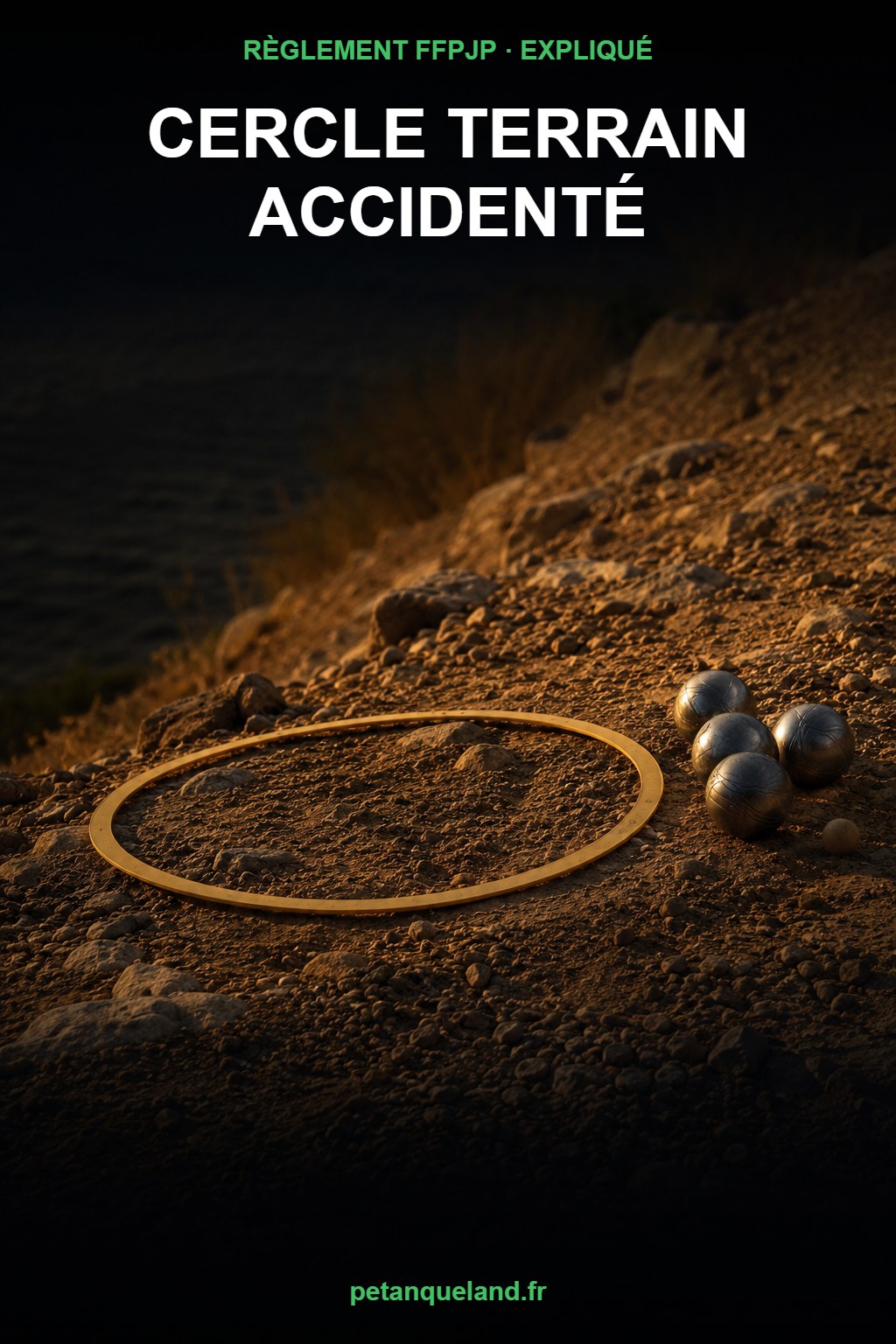
What the rules say about the circle when the terrain is rough
NewsThe FFPJP rules on the throwing circle when the terrain is rough, sloping or uneven: obligations, permitted adaptations and umpire decisions.1.The throwing circle: a reminder of the basic obligations
Before addressing difficult-terrain cases, let's recall the fundamental rules of the throwing circle (Article 6 of the official FFPJP rules). The circle is a rigid object or a ground marking of a diameter of 35 to 50 cm. Each player must keep both feet inside the circle throughout the throw, until the bowl or the jack is placed on the ground.
The feet cannot straddle the outer edges of the circle, and the player must not rise onto the tips of the toes in such a way as to lift the heel out. These obligations apply whether the terrain is perfect or difficult. They know no exception tied to the state of the ground, which many are unaware of.
📐The circle can be a physical object (a plastic or metal circle) or simply drawn on the ground. In competition, teams generally use a plastic circle. On uneven terrain, that's often where the problems begin: the circle won't lie flat.
2.When the ground is uneven: what exactly do the rules say?
Article 6 of the FFPJP rules states that the circle must be placed on the ground in a stable way. On uneven terrain — sloping, stony, waterlogged ground or a very uneven surface — this immediately raises a practical problem: the physical circle can tip over, fail to grip the ground, or be impossible to draw evenly.
The rules provide, in this case, that the team that has to place the circle must choose the most suitable spot within the authorised playing area. If the ground is so uneven that no correct spot is possible within the regulatory area, the umpire is called and it's the umpire who decides: either he validates a substitute spot, or he imposes that the end be replayed from another point.
What the rules don't say: there's no provision allowing you to reduce the circle or make it oval because the terrain is sloping. The circle stays circular and of standard dimensions (35 to 50 cm in diameter).
3.Can you move the circle on uneven terrain?
The question comes up constantly: if the ground is truly impracticable where the circle has to be placed, can you move it slightly? The official answer is yes, but strictly framed.
The principle of the allowed move
At the start of an end, the team with the right to place the circle can choose its spot within the authorised area (usually where the previous end ended, within a radius of about 1 metre from the jack's last position). If the exact ground is uneven, the team can slightly adjust the circle's position, provided it stays within the playing area and that the jack can then be thrown within the regulatory distances (6 to 10 metres in doublette, up to 10 m in triplette).
What's forbidden
You can't move the circle during an end — once the jack has been thrown and validated, the circle is fixed for the entire duration of the end. Nor is it possible to move the circle because a player finds the terrain uncomfortable: only a real impossibility of placing the circle at the exact spot justifies a position adjustment.
🏔️ Paquita's tipOn difficult terrains, always bring a physical circle rather than drawing on the ground. A semi-rigid plastic circle adapts better to the small irregularities of the terrain. If the ground is truly impracticable, call the umpire before throwing: a preventive decision avoids disputes during the end.
4.Table of situations and applicable rules
Here's a recap of the frequent situations on difficult terrain and the FFPJP rules that apply:
| Terrain situation | Allowed action | Forbidden |
|---|---|---|
| Slightly sloping ground | Place the circle normally | Change the size of the circle |
| Stone under the circle | Adjust the position within the area | Remove a stone fixed in the ground |
| Very uneven ground | Call the umpire | Draw an oval instead |
| Puddle of water in the area | Adjust position within the area | Leave the authorised area |
| Circle that tips over | Use a physical circle or redraw | Play with an unstable circle |
| Jack already thrown | Circle fixed for the whole end | Any movement of the circle |
5.Does the feet rule stay the same on difficult terrain?
Yes, absolutely. The feet-inside-the-circle rule is unconditional — it knows no exception tied to the state of the ground. Even on a sloping terrain where standing in a 50 cm circle is uncomfortable, the player must respect this constraint.
What the rules implicitly allow: the player can orient their feet differently in the circle to gain stability on a sloping terrain. They can stand sideways, at an angle, or cross their feet. The essential thing is that both feet are entirely inside the circle at the moment of the throw and until the bowl touches the ground.
Difficulty of respecting the feet rule by terrain Flat terrain · Ease: 9/10 Natural position, no adaptation needed. Very sloping terrain · Ease: 3/10 Notable discomfort — posture adaptation allowed, rule unchanged.6.What the umpire decides in a dispute
In official competition, if a team disputes the circle's position or the ground's conditions, the umpire is the reference. Their decision is immediate and without appeal. In practice, the umpire can validate the current spot if they judge that the terrain, although uneven, allows the circle to be placed in acceptable conditions. They can also impose a move of the circle within the authorised area, to a slightly different but practicable spot, or declare the end to be replayed in extreme cases where the terrain is objectively impracticable at the required spot (rare in practice).
What the umpire will never do: allow a reduced-size circle, accept an oval in place of the circle, or let play go on with a clearly unstable circle. If the terrain is dangerous (slippery or excessively stony), the umpire can require the end to be moved to another area of the terrain.
7.Frequent mistakes on uneven terrain
Here are the most common traps observed on difficult terrains: drawing an oval to get around an obstacle (forbidden — the circle must stay circular); moving the circle during an end (once the jack has been thrown, the circle is fixed); reducing the diameter to avoid an obstacle (forbidden); playing without a circle on difficult terrain to go faster (a fault in its own right). To go further, check out our little-known rules and our free tools.
🏔️ PAQUITA'S BOOK The Ultimate Guide to Difficult TerrainsAdapting your game to uneven, stony or sloping terrains is a skill that can be worked on. This guide explains how to read the ground, choose your trajectory and maintain your precision even in the worst conditions.
📗 Discover the bookFAQ — Your frequent questions
Can we place the circle on a slope?+ Yes. The FFPJP regulations do not provide an exception for sloping terrain: the circle must be placed in the required location, even on a slope. The team may adjust the position slightly within the permitted area to find more stable ground. In case of real impossibility, the referee is called. Can we move the circle if the ground is uneven?+ Yes, but only at the start of the end and in the authorized playing zone. Once the jack is launched and validated, the circle is fixed for the entire duration of the round. No movement during the lead is permitted, even if a player trips. Is an oval circle acceptable on uneven terrain?+ No. The circle must remain circular, regardless of the quality of the terrain. The FFPJP regulations do not authorize an oval or rectangular shape, even in the event of an obstacle on the route. We adjust the position of the circle, not its shape. Does the foot rule change on steep terrain?+ No. Both feet must remain entirely within the circle during the entire throw, regardless of the terrain. The player can adapt his posture (stand aside, at an angle) to gain stability, but the rule remains the same on flat or steep terrain. What happens if the circle slips during the round?+ The circle must be returned to its original position. This is why it is strongly recommended to mark the location of the circle on the ground (discreet line) before starting the route on unstable ground. The decision on the exact position rests with the referee in the event of persistent disagreement. 📎 Related articles RulesThe little-known rules of pétanque ToolsFree PetanqueLand tools HomePétanque by Paquita© Pétanque by Paquita — petanqueland.fr ·
📘 Discover my books on PetanqueLand
Article based on the official FFPJP rules of pétanque. To be adapted according to local club customs.